Perfume bottles, serum droppers, and cosmetics jars are the most technically demanding products in e-commerce photography. Glass is transparent and reflective at the same time; metallic caps behave like mirrors; liquid changes color depending on the light passing through it. A shot that would be perfectly acceptable for a cutting board or a phone case looks cheap the moment those materials are involved — and on Amazon, where fragrance shoppers judge scent family partly by liquid color, an inaccurate image costs sales and drives returns.
Why Glass Breaks the Usual Product Photo Workflow
Point a standard softbox at a glass bottle and the surface reports back everything in the room: the light itself as a hard white blob, the camera, the photographer, the edges of the table. Transparent products are not lit directly the way opaque products are — they are defined by what reflects into their edges. Studios solve this with gradient panels and black flags placed to draw clean bright and dark lines along the bottle's silhouette, which is what gives premium fragrance advertising that liquid-smooth look.
Most sellers do not have that setup, and this is where retouching carries the weight. As long as the source photo is sharp and reasonably exposed, a retoucher can rebuild what the lighting missed: cleaning reflection shapes into deliberate gradients, removing the room from the glass, and restoring the crisp edge lines that make a bottle read as premium rather than snapshot.
The Retouching Workflow, Step by Step
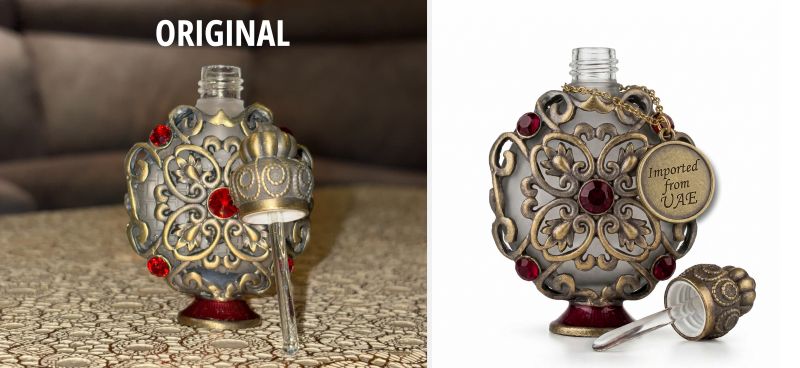
Professional perfume and beauty retouching follows a consistent sequence. First, cleanup: dust, fingerprints, and micro-scratches are invisible to the eye on set but glaring at Amazon zoom resolution — every one gets healed out. Second, reflection reconstruction: messy real-world reflections on the glass and cap are replaced with smooth, intentional gradients that suggest a high-end studio, keeping the highlights consistent with a single believable light direction.
Third, liquid correction: the fluid inside is color-graded back to its true tint, since backlighting on set routinely washes amber out to pale yellow or turns pink oils muddy. Fourth, the background is cut and replaced with pure white (RGB 255, 255, 255) as Amazon's main-image policy requires, and a realistic contact shadow is rebuilt underneath — without it, the bottle appears to float. Finally, the image is sharpened and exported at 2000 pixels or more on the longest side so Amazon's hover-zoom stays crisp.
Metallic Caps and Pumps Need Separate Treatment
The gold and silver hardware on fragrance bottles behaves differently from the glass body — a mirror finish either looks brilliant or looks like a smudged spoon, with little in between. Retouchers typically rebuild cap reflections separately from the bottle, keeping metal contrast punchy while the glass stays soft. Getting both materials right in one frame is the single clearest difference between amateur and professional beauty product images.
What This Looks Like in Practice
The image at the top of this article is a real before-and-after from my own client work: a raw perfume oil bottle photo transformed into an Amazon-ready main image. You can see the same approach in my Yara Lattafa Amazon main image optimization case study, and more work in the portfolio. The same workflow applies to serums, droppers, candles, skincare jars, and any product where glass or liquid is part of the presentation.
Amazon Compliance for Beauty Listings
Beauty and fragrance main images follow the same core rules as every category: pure white background, product filling roughly 85% of the frame, no props, badges, or text overlays, and a minimum of 1000 pixels on the longest side. Side images are where the category earns its conversions — texture swatches, ingredient callouts, size-in-hand references, and lifestyle scenes. But none of those work if the hero shot fails to make the bottle look like it is worth the price, which is why the main image retouch deserves the largest share of the image budget.
Frequently Asked Questions
Why are perfume bottles so hard to photograph?
Glass is transparent and reflective at the same time — it picks up the entire room, the camera, and the light sources in its surface. Professional results come from controlled gradient lighting on set, then retouching to rebuild clean reflections, remove distracting artifacts, and restore liquid color accuracy.
Can bad perfume product photos be fixed in retouching?
Usually yes. As long as the bottle is sharp and reasonably lit, a retoucher can remove dust and fingerprints, rebuild glass reflections, correct liquid color, replace the background with pure white, and recreate studio-quality shadows — often making a phone photo look like a studio shoot.
What does Amazon require for beauty product main images?
The same rules as every category: pure white background (RGB 255,255,255), the product filling around 85% of the frame, no props or text, and at least 1000px on the longest side. Fragrance listings additionally benefit from accurate liquid color, since shoppers use it to judge the scent family.
Conclusion
Glass, liquid, and metal are unforgiving materials, but they are also an opportunity: because most competitors get them wrong, a properly retouched perfume or cosmetics image stands out in search results immediately. Whether the source photo comes from a studio or a phone, the retouching pass — cleanup, reflection rebuild, liquid color correction, white background, and true shadow — is what separates a listing that looks premium from one that looks mass-market. If your fragrance or beauty listing is underperforming, the hero image is the first place to look.